Credits & legal
The people behind it
Junk Yard was made by a small team at Williams in Chicago in 1996. This tribute stands on their work, and on the photographers and writers who documented the machine.
I played Junk Yard through my four years of high school, almost every day. It holds a dear spot in my heart.
Williams, 1996
The Junk Yard Dogs
The original machine was designed, programmed, drawn and built by these people. Credits follow the Internet Pinball Database and the 1997 Williams website.1,3
In memory of Barry Oursler, who dreamed up the wrecking ball. He died in February 2022.5
| Concept | Barry Oursler, Dwight Sullivan, Adam Rhine |
|---|---|
| Project lead | Dwight Sullivan |
| Design | Barry Oursler, Dwight Sullivan, Pete Piotrowski |
| Software | Dwight Sullivan, Graham West |
| Artwork | Pat McMahon, Paul Barker, Linda Deal (Doane) |
| Dot-matrix animation | Adam Rhine, Brian Morris |
| Mechanical engineering | Zofia Bil, Brad Cornell |
| Music and sound | Kurt Goebel; guitar by Vince Ponterelli |
| Voices | Tim Kitzrow and Williams staff |
Photographs
The people who photographed their machines
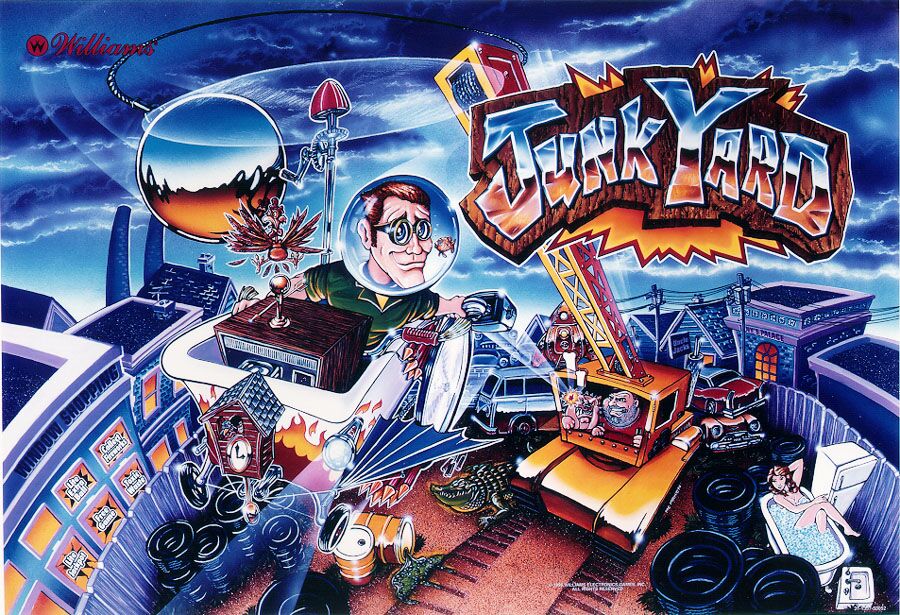
Every photo of a real machine on this site comes from the Junk Yard page of the Internet Pinball Database, and each one carries its photographer's name wherever IPDB records it: Allen Shope, Caio Wiseblood, Maximilian Wegner, Jean-Pierre Renault, Steve Nordseth and Harold Balde. The backglass art, flyers and poster are Williams' own; a few photos, such as the Magic Bus close-up and the apron credits, have no photographer listed on IPDB, so they are credited to IPDB.
Those photos were also the raw material for the recreation: the playfield art, the toy textures and the reference images for the 3-D models all start from them. Thank you.
Writers and historians
Who kept the story
Per Martinson, for "Junk Yard: the untold story" and the interviews behind it. Joseph DeVincentis, for the 1997 rulesheet. The San Diego Pinball Club, for its cheat sheet. The keepers of Cows and Easter Eggs. The Internet Archive, which still has the 1997 Williams website. And the Visual Pinball authors of the Junk Yard table (mfuegemann and the VPW team), whose script showed how the mechanisms behave.
Sources
Where the facts come from
- Internet Pinball Database, Williams "Junk Yard", IPDB #4014 (production, credits, notes from Barry Oursler, slogans).
- Williams Electronics Games, Junk Yard Operations Manual, January 1997 (rules, story, recipes, apron card), via IPDB.
- Williams, official Junk Yard website, 1997 (feature pages, "The Story" by Dwight Sullivan, team list), via the Internet Archive.
- Per Martinson, "Junk Yard: the untold story", Medium, February 2022 (design history, interviews with Barry Oursler, Adam Rhine and Kurt Goebel, Williams engineering files at The Strong).
- "Barry Oursler dies", Pinball News, 22 February 2022.
- B. Oursler and D. Sullivan, US Patent 5,833,236, "Wrecking ball play feature for a pinball game", filed August 1997, granted November 1998.
- Joseph DeVincentis, Junk Yard rulesheet v0.5, 1997, via IPDB.
- "Junk Yard (pinball)", Wikipedia (digital versions, Tony's Palace).
- Williams, Service Bulletin #92, November 1996 (wrecking-ball chain).
- Pinball FX (Zen Studios) wiki, Junk Yard table guide (timers and values of the licensed version).
- San Diego Pinball Club, Junk Yard cheat sheet (bus-ride awards, Secret Mania).
- Williams, Junk Yard game ROM revision notes (versions 1.0 to 1.2).
- Cows and Easter Eggs (pinball-wizard.se), Junk Yard entry (Secret Mania, DOHO, Cow Attack, Midnight Madness).
- Tim Kitzrow, voice of NBA Jam: interview, Shacknews; "NBA Jam", Wikipedia.
Software and licences
Open-source parts
- PinMAME runs the original program and sound board. Used under the PinMAME licence (the MAME licence, moving to BSD 3-Clause): licence text. Source: github.com/vpinball/pinmame (commit ebe412d), built for the browser with a few small changes to run in step with the game. The exact source we build from, with our changes and the build script: pinmame-wasm-source.tar.xz (1.2 MB).
- three.js draws the machine in 3-D. MIT licence: licence text.
Fan-tribute notice
This is an unofficial, non-commercial fan tribute. It is not affiliated with, sponsored by or endorsed by Williams, WMS Industries, their successors, or the owners of the Junk Yard trademark and licences.
Junk Yard, its name, artwork, characters, sounds, music, dot-matrix graphics and program ROM belong to their respective owners. They are used here only to celebrate the machine, without charge, advertising or payment of any kind.
About the ROM. The original program and sound ROM images are copyrighted. The game loads them only to play this tribute in your browser. Don't download, copy or redistribute them unless you are legally entitled to.
Photographs of real machines belong to their photographers and are credited where they appear. Everything else (the 3-D models, the physics, the redrawn art and this site) was made for this tribute.
If you own rights in any of this material, or took one of the photos, and want something changed, credited differently or removed, message @scheemunai on X and it will be done promptly.
Licensed digital versions of Junk Yard are available from Zen Studios (Pinball FX). If you enjoy this tribute, play the real thing on location or in their game.